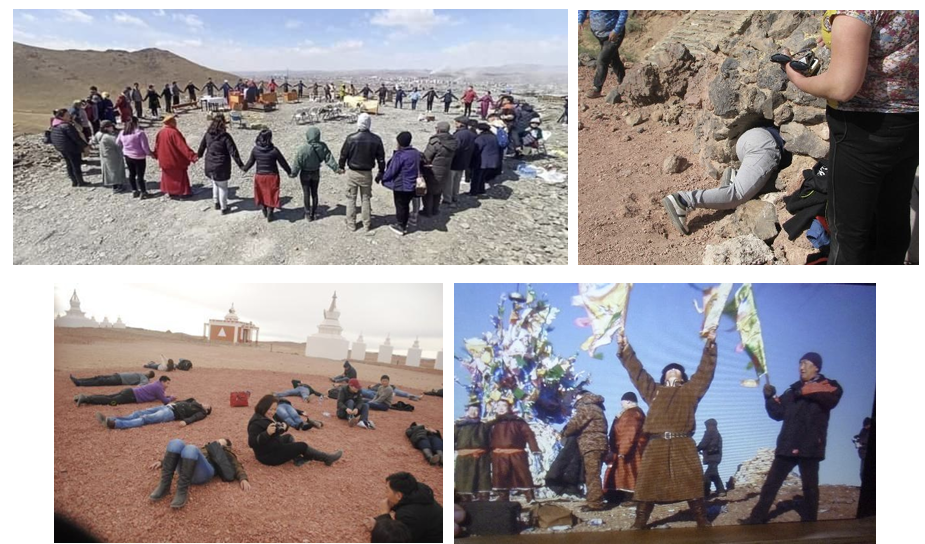
International workshop organised by the Centre de recherches sur les civilisations de l’Asie orientale (CRCAO UMR 8155, CNRS, Collège de France, EPHE-PSL, Université Paris Cité)
Date: Thursday 15 October 2026
Location: Collège de France – Institut des civilisations Adresse : 52 rue du Cardinal Lemoine, 75005 Paris
Salle : Françoise Héritier, and Zoom
Language: English
Organisers: Aurore Dumont (Université Paris Cité, CRCAO) & Isabelle Charleux (CNRS, CRCAO).
Contacts: aurore.dumont@u-paris.fr, isacharleux@orange.fr
Following the collapse of the communist regimes in 1990, a wide range of new religious trends have emerged and gained increasing popularity across Inner Asia – especially the Mongol cultural areas (Mongolia, Mongol-populated regions of China and Russia), as well as Tibetan cultural regions, Kazakhstan, and the Altai. These new trends involve both transformations within “traditional” religions – Buddhism, Islam and shamanism – and the rise of religious movements such as neo-shamanism, prosperity-oriented cults and New Age currents influenced by Russian esotericism (e.g. Agni Yoga). Often grounded in imagined archaic spiritual traditions, these emerging religious movements position themselves in contrast to
established “world religions.” They introduce new terminologies, frequently drawing on metaphors of electricity, and promote ritual practices centred harnessing “energy” (energi) from natural elements, often combined with eschatological motifs. Their evolving ritual practices, narratives, and doctrinal frameworks (when they are made explicit) draw on a broad array of sources, including Buddhism and its Shambhalist eschatology, early twentieth-century religious movements such as Ak jang (“Burkhanism”) in the Altai, shamanism, local folklore, and other religious motifs. These new religious forms are frequently intertwined with ethno-national agendas and also generate at the same time dynamics of interethnic exchange and
transnational convergence.
This international workshop seeks to examine how these new movements reflect local and global transformations, social anxieties, and geopolitical challenges in the contemporary contexts of Inner Asia marked by urbanization, glocal and ethnic dynamics, the expansion of the market economy, as well as heightened uncertainty linked to warfare, environmental degradation and climate change. It also aims to analyse these emerging trends in relation to the opposition they may encounter from institutional Buddhism and some authoritarian states’ prohibitive measures.
This workshop inaugurates the program “Religions et savoirs en mutation en Asie intérieure” (Religions and Changing Knowledge Inner Asia) of the new “Pôle Études mongoles” (Mongol studies Team) founded in January 2026 at the Centre de recherches sur les civilisations de l’Asie orientale (CRCAO). Three discussants from three other cultural areas (China, Korea, Tibet) will provide a comparative perspective on these issues.
Program
-
- Introduction – Isabelle Charleux & Aurore Dumont
- Saskia Abrahms-Kavunenko (Kyoto University): “Mongolian Connections: Visionary Science, Mysticism and the Dispersed Birthing of the New Age”
- Isabelle Charleux (CNRS/CRCAO): “No more gods? The cult of natural elements in in contemporary Mongolian pilgrimage”
- Valeria Gazizova (Heidelberg University): “Art, Healing and Neo-Nomadic Spirituality of the Steppe”
- Valentina Punzi (EPHE/CRCAO): “From the bottom of the ocean to the top of a thousand mountains: The reinvention of Zhang Zhung civilization in contemporary Chinese pop-culture”
- Alya Solovyeva (University of Tartu, Estonia): “Resilient Eschatology and Cosmological Sovereignty in Contemporary Inner Asia”
- Ma Xin (EPHE): “From Anonymous Forces to Ancestral Voices: Naming, Placing,
and Calling Spirits in Barga Shamanism”.